
Community blog
Praxen 1.2: Now Aligned to the 2026 OWASP Top 10 for LLM Applications
Today we're releasing Praxen 1.2, aligned to the newly published 2026 OWASP Top 10 for LLM Applications.
The OWASP GenAI Security Project — the open, vendor-neutral community that maintains the industry's most widely-adopted LLM risk model — is shipping the 2026 revision of the list, and Praxen 1.2 ships aligned to it from day one.
This is more than a terminology update. Praxen now evaluates agent risks using the latest OWASP guidance, helping teams connect what an agent can do, what it is allowed to do, and where its controls may fall short against the industry's most current risk model.
For developers and security teams, that means Praxen findings are easier to interpret, prioritize, and communicate using a framework the broader industry already recognizes.
"The 2026 OWASP Top 10 reflects how quickly AI application risk is evolving. Praxen 1.2 brings that guidance directly into the review process, so teams can evaluate real agent capabilities, permissions, and behavior against the latest industry standard."
— Steve Wilson, creator of Praxen and project co-lead for the OWASP Top 10 for LLM Applications
What's new in Praxen 1.2
Alongside the updated OWASP support, this release includes several improvements designed to make reviews clearer and more useful:
- Updated risk mapping aligned to the 2026 OWASP Top 10 for LLM Applications
- Clearer, more consistent findings through an improved analysis and scoring process
- Scan-to-scan comparisons showing what is new, resolved, or unchanged
- A new human-readable, shareable Worker Remit for developers, security reviewers, auditors, and leadership
- Reliability improvements so analysis holds up on large, complex codebases instead of stalling
- Scan scoping — point Praxen at the specific component in a monorepo or multi-agent project
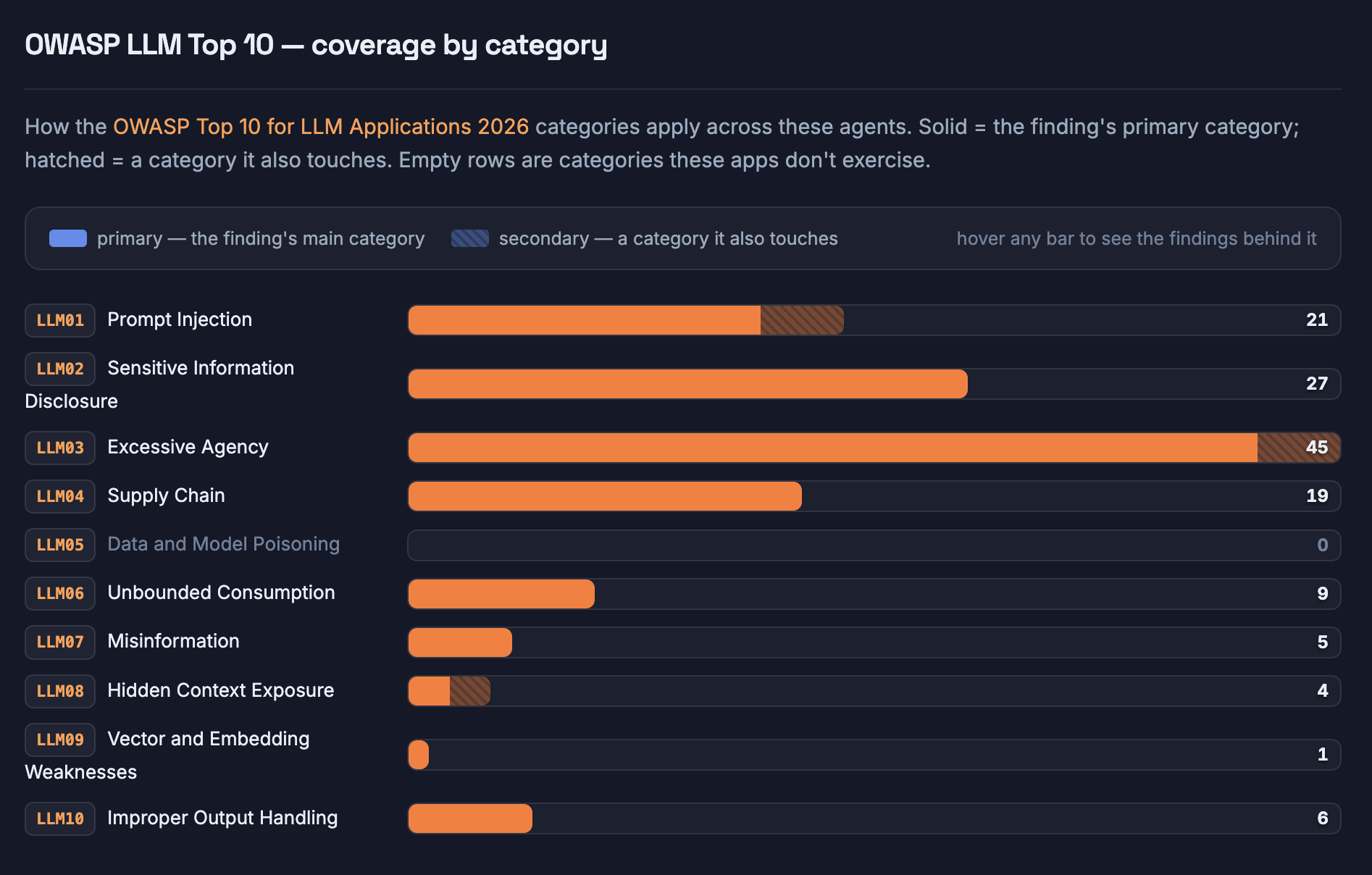
Praxen's public 12-agent benchmark remains available for anyone who wants to inspect its performance on real software.
The benchmark was designed to be transparent and repeatable. Each target was analyzed three times against identical inputs, with the median result published. An independent source review examined roughly 130 findings and found that every reviewed issue traced back to real code or configuration.
Why the OWASP update matters
Praxen is built to verify whether an agent's actual capabilities and behavior match the role it was authorized to perform.
With 1.2, those reviews are now grounded in the latest OWASP risk categories. Teams can move from a raw technical finding to a recognized security concern without manually translating between the two.
That makes Praxen more useful not only for developers, but also for security teams, risk leaders, and auditors who need a common language for discussing agent security.
Built in the open
Praxen is available under the Apache 2.0 license as part of the Open Agent AI Security community. The OWASP Top 10 for LLM Applications, and the companion Agentic AI Top 10, are maintained by the OWASP GenAI Security Project — an open, vendor-neutral community — and Praxen 1.2 adopts both 2026 lists as its default risk mapping.
Get Praxen 1.2
Praxen 1.2 installs from the Open Agent AI Security community marketplace — one command to add it, one to install.
Claude Code
claude plugin marketplace add open-agent-ai-security/plugins
claude plugin install praxen@open-agent-ai-security
OpenAI Codex
codex plugin marketplace add open-agent-ai-security/plugins
codex plugin add praxen@open-agent-ai-security
Then point it at an agent and ask for a Praxen analysis. Full instructions, including the no-marketplace path for any other coding agent, are in the installation guide; the project home page has the benchmark results and worked example reports, and the source lives on GitHub.
The same marketplace serves every plugin from this community, so anything we publish next is one install away.
Try the release, run it against your agents, and let us know what you find.